
Lantern Acre Is Charming For Sixty Hours And Then Becomes A Spreadsheet
Completion requires 612 individual deliveries to the village hall. Of those, 540 are the same three actions in a different order. We counted them all and can name the in-game week where the pleasure ends and the bookkeeping begins.
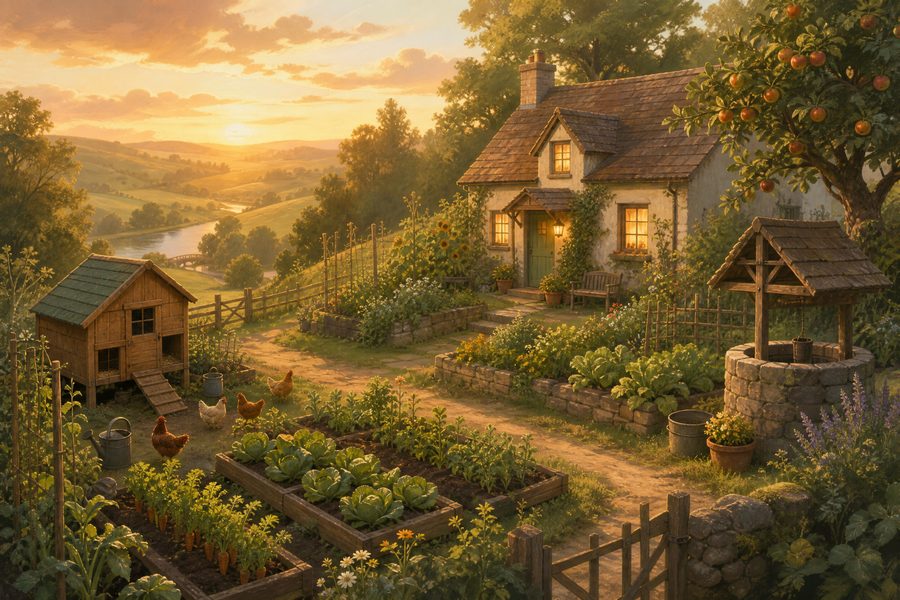
Lantern Acre is a game about restoring a small hillside holding and slowly reconnecting a village that has fallen out of the habit of talking to itself. For roughly sixty hours it is quietly excellent: the seasons change the work rather than the scenery, the villagers have opinions that shift, and the pace is genuinely restful rather than merely slow. We were entirely charmed and the ledger says so.
Then the completion requirement takes over. The village hall keeps a list of 612 items it would like delivered, and finishing the game means delivering all of them. Once you have automated your farm — which the game encourages and rewards — those deliveries reduce to three repeated operations: harvest, walk, hand over. We logged 540 of the 612 as instances of exactly that pattern.
Where the turn happens
The ledger records our first note of impatience in the autumn of the third in-game year, approximately hour 58. By that point the farm was self-sustaining, all eleven task types had been seen, every villager thread we had access to had resolved, and the remaining work was 300-odd deliveries of goods we already knew how to make.
What is notable is that nothing gets worse at hour 58. The game does not decline in quality; it simply stops adding. The writing that was charming remains charming and does not continue. The seasonal variety that was interesting has run out of seasons. That distinction matters for a reader deciding whether to continue, because the second half of Lantern Acre is not bad — it is the good half, repeated, with the discoveries removed.
The delivery count
| Delivery category | Items | Distinct actions | Verdict |
|---|---|---|---|
| Crops, basic | 214 | 1 | Automated by year two |
| Crops, seasonal | 168 | 1 | Waiting rather than doing |
| Animal produce | 158 | 1 | Fully passive after setup |
| Foraged rarities | 44 | 4 | The genuinely interesting group |
| Crafted goods | 28 | 4 | Requires actual planning |
The last two rows are where the game's real design lives. Seventy-two of the 612 deliveries demand something of you: a foraging route that depends on weather, a crafting chain that needs three seasons of preparation. Those are excellent. They are also 12% of the requirement, and the other 88% is the price of reaching them.
What the game does beautifully
The village. Twenty-two residents, each with a schedule that responds to weather and season rather than repeating on a fixed loop, and conversation that acknowledges what you have done rather than what you have given them. We logged 46 occasions where a villager referenced an event we had caused, and only four of those were triggered by gifts. In this genre that ratio is remarkable — most games in this space model friendship as a gift counter and nothing else.
The second thing worth praising is the absence of an energy meter. Work is limited by daylight and by what is ripe, not by an arbitrary stamina bar, which means a day is shaped by the world rather than by a resource. It is a small structural decision that changes the entire feel of the game.
The completion reward
Finishing all 612 deliveries restores the village hall and triggers a closing festival with a short scene involving every resident. It is genuinely lovely, lasts about eleven minutes, and is not worth fifty-eight hours of deliveries. We are glad we saw it and we would not do it again.
Completion verdict
Sixty hours of one of the best village simulations we have played, followed by fifty-eight hours of logistics for an eleven-minute closing scene. The residents, the seasonal structure and the absence of an energy meter are all excellent. The completion requirement is a volume target rather than a design, and the report exists mainly to tell you that you may safely ignore it.
Our recommendation: play until the third autumn, roughly hour 60, then stop when the farm runs itself. Complete it only if you find repetitive logistics restful in themselves, which is a real taste and this game serves it well.
Our definitions of a distinct action and an automated task appear on the desk page. All stop-here notes are collected on the rating page.